

Weather and hurricanesExplainer
Sargassum 2026 in Quintana Roo: how many tons are there? Why the figures don't match
Sargassum figures for 2026 range from 3,500 to more than 156,600 tons because each source measures something different: estimated arrivals, collection, municipal removal or algae at sea. What each says, what Fonatur plans and what is expected in late December.
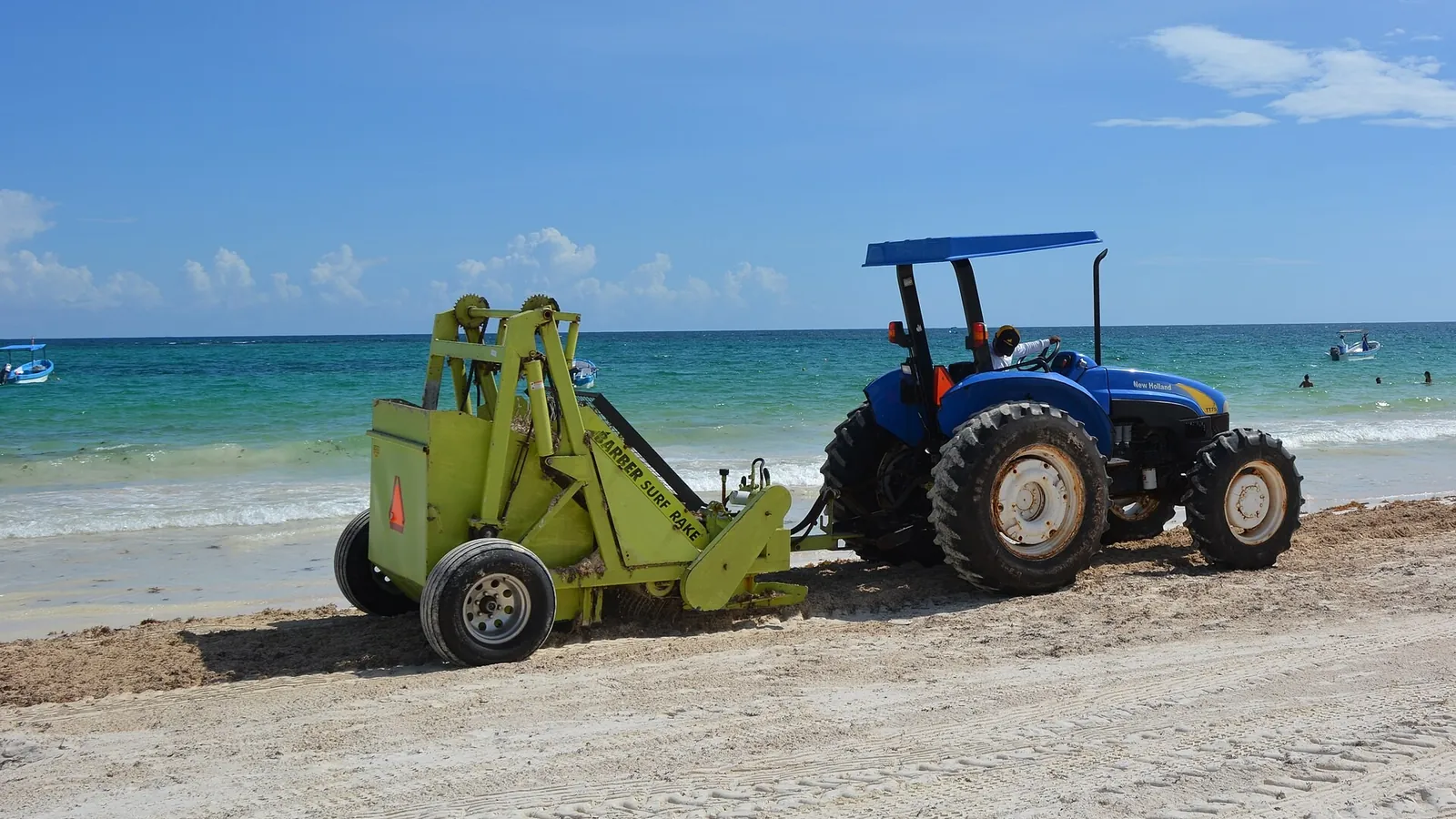
There is no single tonnage figure for sargassum in Quintana Roo in 2026, because each source measures something different. As of October 30, 2026, the state had exceeded 156,600 tons collected, according to Quadratín Quintana Roo. In early October, state monitoring estimated about 150,000 tons of arrivals, according to Mexico News Daily, and the Secretaría de Marina (Navy Secretariat) reported more than 70,230 tons removed with its own resources. These are figures of different kinds and should not be compared with one another.
What tonnage figures circulate in 2026?
- Collected in the state: more than 156,600 tons as of October 30, according to Quadratín Quintana Roo.
- Removed by the Navy with its own resources: more than 70,230 tons, versus 18,500 in all of 2025, according to the same article.
- Collected in the state, according to the Navy, around mid-October: more than 123,000 tons, versus more than 92,000 in all of 2025, according to UnoTV.
- Estimated arrivals from state monitoring: about 150,000 tons in 2026, versus 94,000 in 2025, according to Mexico News Daily.
- Algae in the Caribbean Sea: 3,920 tons counted by the Navy on October 8, 2026, with about 31 tons expected on the coast in 24 hours, according to PorEsto.
- Removed by Isla Mujeres: more than 3,500 tons in 2026, a figure from the municipality itself, without independent verification.
Why aren't they comparable?
Four differences keep these figures from being added or subtracted.
- Estimated versus collected. An arrival estimate calculates how much sargassum reaches or will reach the coast; a collection figure counts what has already been removed. The 150,000 tons from state monitoring and the 123,000 collected that the Navy cites are different measures.
- Who removes and counts. The state, the Navy and the municipalities each report what falls to them. The Navy appears with 18,500 tons in all of 2025 in one article and with more than 92,000 in another. The articles do not explain the difference; what they do indicate is that one figure refers to what was removed with its own resources and the other to what was collected in the state. They also do not explain how the state figure of 156,600 tons and the Navy's 70,230 relate to each other.
- Where it is measured. The 3,920 tons are algae counted at sea; the 31 tons expected are what is forecast to reach the coast in 24 hours. Neither is a total for the year.
- Cutoff date. The data are from October 8, mid-October and October 30, 2026. With continuous arrivals, each date changes the total.
What do the traffic-light alerts say?
The Navy publishes an archive of daily Caribbean sargassum bulletins, prepared by the Instituto Oceanográfico del Golfo y Mar Caribe (Gulf and Caribbean Sea Oceanographic Institute). Its general traffic light differs from the one used by the state Secretaría de Ecología (Ecology Secretariat, SEMA) in its monitoring of 140 beaches, and may not reflect the situation at each beach. How the Navy defines each level was not reviewed.
An example with a date: on October 8, 2026 the Navy rated the level “very low,” with a green traffic light, while the state network reported 21 beaches with excessive sargassum, 34 abundant, 26 moderate, 49 low and 5 with none. Traffic lights change from one day to the next, so this article does not state the condition of any beach; the daily bulletin serves that purpose.
What does Fonatur plan for 2027?
Fonatur will allocate 500 million pesos during 2027 to sargassum management in Quintana Roo, after it stopped operating in Cancún and Cozumel in 2025, according to PorEsto (October 7, 2026). Its director general, Sebastián Ramírez Mendoza, said it will coordinate the Estrategia Nacional de Atención y Manejo del Sargazo (National Sargassum Response and Management Strategy), which covers research, collection, disposal, regulation and utilization.
The plan includes four final disposal sites in the state (a detail that appears in a related article on the same page, not in the main text) and uses such as biofertilizers, biochar and biogas, in addition to reducing sand loss from cleanups.
Separately, Playa del Carmen announced in an interview that its municipal spending against sargassum will rise to 100 million pesos in 2027, from 80 million in 2026. It is a verbal announcement, independent of the federal budget, and depends on formal approval of the budget.
What is done with the collected sargassum?
The 4th EU-Caribbean Global Gateway Conference on Sargassum was held in Cancún on October 1 and 2, 2026, on the theme of a sargassum value chain in the Caribbean. Management technologies, financing schemes, circular economy and productive uses were discussed. The state's head of Economic Development mentioned, in his official appearance of September 30, 13 companies interested in using sargassum within the Polo de Economía Circular (Circular Economy Hub).
What is expected for December?
Quadratín reports that a large influx of sargassum is forecast for late December 2026. Separately, the Red de Monitoreo del Sargazo de Quintana Roo (Quintana Roo Sargassum Monitoring Network) said in early October that the state is entering a seasonal decline after the June and July peak, with a gradual reduction expected in November and December, although local landings may still occur. The reports consulted do not specify the magnitude of the December influx or which beaches it would affect.
Sources
- MediaSupera Quintana Roo las 156 mil toneladas de sargazo en 2026
- MediaSecretaría de Marina reporta bajo nivel de sargazo en Quintana Roo
- Official sourceBoletines de sargazo: archivo diario
- MediaPlaya del Carmen starts October with new sargassum arrivals, though seasonal decline is underway
- MediaNuevo recale de sargazo golpea las playas de Tulum; persisten afectaciones
- MediaIsla Mujeres participa en encuentro internacional para avanzar hacia nuevas soluciones ante el sargazo
- MediaFonatur regresará a Quintana Roo; destinará millones de pesos al manejo del sargazo
- MediaPlaya del Carmen to Invest 100 Million Pesos in Sargassum Fight
- MediaSEDE reporta avances en inversión, empleo y apoyo a empresas de Quintana Roo